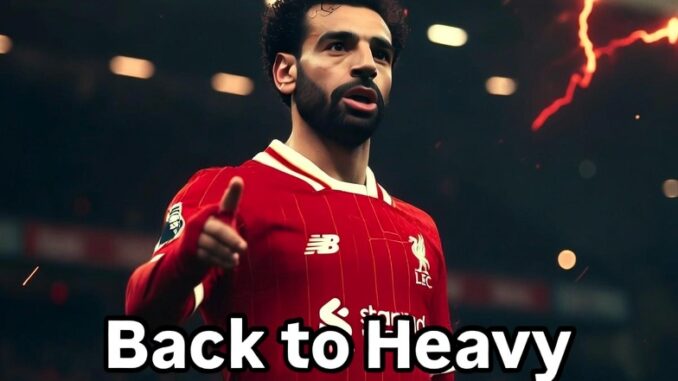
**Mohamed Salah Issues Scathing Statement Calling for Return to “Heavy Metal” Football**
In the aftermath of Liverpool FC’s damaging 4-2 defeat to Aston Villa on May 16, 2026, Mohamed Salah took to social media with a message that has sent shockwaves through Anfield and beyond. The Egyptian King, usually measured in public criticism, posted a pointed statement demanding a return to the “heavy metal” football that defined Jürgen Klopp’s transformative era. With the Premier League season entering its final week and Liverpool’s place in next season’s Champions League hanging by a thread, Salah’s intervention feels like a cry from the heart of a dressing room that has lost its identity.
The statement read in part: “This is not us. We’ve crumbled. We need to go back to heavy metal — full intensity, press like our lives depend on it, attack with no fear. The opponents used to dread coming to Anfield. Now they smell blood. We fight for the Champions League spot in the last game. No more excuses.” Several key teammates, including Virgil van Dijk and Trent Alexander-Arnold, reportedly liked or reacted positively to the post, amplifying its significance.
This is not just another frustrated player rant. At 33 years old and in what many believe could be his final season at the club, Salah has 22 goals and 13 assists across all competitions this term. Yet his words carry the weight of a leader watching a proud institution drift. Liverpool sit fifth in the table, a staggering decline from their title-winning campaign the previous year. Twelve league defeats already — more than in the entirety of Klopp’s final two seasons combined. The once-feared pressing machine has become porous and passive. Salah’s message is both diagnosis and prescription.
### The Context: A Season of Decline
To understand the gravity of Salah’s statement, one must examine the broader picture of Liverpool’s 2025/26 campaign. Arne Slot’s first full season in charge began with promise but quickly unraveled. After a solid start that saw them challenge for top spot into the new year, injuries, tactical rigidity, and a noticeable drop in physical intensity derailed progress. Key absences — particularly in midfield and at centre-back — exposed underlying squad depth issues that Fenway Sports Group’s careful recruitment strategy has yet to fully resolve.
The Aston Villa match exemplified everything Salah alluded to. Ollie Watkins ran riot, scoring twice, while Liverpool’s high line was repeatedly exploited. Villa, fighting for their own European qualification, pressed aggressively and won the second-ball battles that once belonged to the Reds. Liverpool led twice but collapsed after halftime, conceding three goals in a 20-minute spell that laid bare defensive frailties and a lack of midfield control. Post-match, Slot spoke of “fine margins” and “individual errors,” but the performance metrics told a harsher story: Liverpool were outrun, outfought, and out-thought.
Fan reaction has been visceral. Boos rang around Villa Park and have echoed at Anfield in recent weeks. Social media is flooded with nostalgia for Klopp’s fist-pumping, chest-thumping brand of football. “Heavy metal” — the term Klopp himself popularized — refers to a high-octane, full-throttle style: relentless Gegenpressing, rapid transitions, overlapping full-backs, and front-three combinations that terrorized defenses. Under Slot, the approach has been more measured, possession-oriented, and at times overly cautious. While aesthetically pleasing in patches, it has lacked the soul and aggression that made Liverpool Europe’s most feared side between 2018 and 2024.
Salah’s numbers remain elite, but even he has looked isolated at times. His partnership with Luis Díaz and new signing Federico Chiesa has shown flashes of brilliance, yet the service from midfield has been inconsistent. When asked about the statement, former Liverpool captain Jordan Henderson, now plying his trade elsewhere, told reporters: “Mo is the ultimate professional. If he’s speaking out, it’s because he cares deeply. That intensity was our identity.”
### What “Heavy Metal” Really Means
For those who lived through the Klopp revolution, “heavy metal football” is more than a catchy phrase. It is a philosophy. Klopp borrowed the term from heavy metal music to describe the unrelenting, loud, aggressive, and emotionally charged nature of his teams. Full pitch presses, counter-pressing within seconds of losing possession, and a refusal to accept anything less than maximum effort.
Data from Opta and StatsBomb highlights the shift. Under Klopp in 2023/24, Liverpool averaged 12.8 high-intensity presses per game leading to turnovers in the opposition half. This season, that figure has dropped to 8.4. Expected Goals (xG) from open play has declined, while opposition xG against Liverpool has risen sharply, particularly on transitions. Salah’s call is not nostalgia for nostalgia’s sake — it is rooted in measurable performance decline.
Tactically, Slot has favored a 4-2-3-1 or 4-3-3 with inverted full-backs and a more structured build-up. While this has improved certain passing networks, it has reduced the chaos and unpredictability that defined Klopp’s sides. Opponents no longer fear the whirlwind; they prepare for a controlled but beatable opponent. Salah, who thrived on the chaos — making runs in behind, linking with overlapping full-backs, and pressing from the front — clearly feels the current system stifles the team’s greatest strengths.
### The Leadership Vacuum and Dressing Room Dynamics
Salah’s statement also shines a light on leadership. With James Milner and Henderson departed, and Jordan Henderson long gone, the veteran core is thinner. Van Dijk remains a giant, but at 34 his explosive pace has diminished. Salah has effectively become the dressing room’s senior voice alongside the Dutchman. His willingness to speak publicly suggests frustration has reached boiling point.
Insiders report tense conversations behind the scenes. Training sessions have reportedly been more physical in recent weeks as coaches attempt to rediscover intensity. One source close to the squad told me: “The players respect Slot, but they miss the fire. Mo is saying what many are thinking. They want to run through walls again, not just pass the ball around.”
This raises questions about Slot’s future. The Dutchman was appointed as a natural successor — calm, tactical, modern. Yet results have not matched expectations. Liverpool’s trophy cabinet remains empty this season, a far cry from the domestic and European success of recent years. Speculation is rife about potential replacements: names like Xabi Alonso, Ruben Amorim (if he moves), and even a sensational return for Klopp have been floated, though the latter seems unlikely.
Slot himself addressed the situation in a press conference: “I understand the emotions. We all want the same thing — success for Liverpool. The team will be different next season. We are building something.” His words sound measured, but in football, results dictate the narrative. With one game left against Brentford, a win is essential to secure Champions League football. Anything less could trigger a full-scale review.
### Salah’s Legacy and Contract Situation
At 33, Salah is entering the twilight of his Liverpool career, yet he remains world-class. His 2025/26 numbers prove he still has the hunger. But contract talks have been quiet. Reports suggest he is open to one final big contract, possibly in Saudi Arabia, though his heart remains at Anfield. By issuing this statement, Salah is not just fighting for this season — he is shaping the club’s direction for the next chapter.
His journey at Liverpool is already legendary: from seemingly expensive signing in 2017 to serial winner, Ballon d’Or contender, and club icon. He has scored over 200 Premier League goals for the Reds. Fans adore him not just for goals but for his work rate, humility, and connection with the city. When Salah speaks, Liverpool listens.
Pundits have weighed in heavily. Jamie Carragher, never one to hold back, said on Sky Sports: “Mo is right. This team has gone soft. You can’t win at the highest level without that dog, that mentality. Heavy metal isn’t just about running — it’s about attitude.” Gary Neville countered that tactical evolution is necessary, but even he admitted the current side lacks “edge.”
### The Road Ahead: Rebuild or Revolution?
Liverpool face a critical summer. Key decisions loom on contracts for Salah, Van Dijk, and Alexander-Arnold. The midfield requires dynamism — players who can both control games and press relentlessly. A new centre-forward to complement (or eventually replace) Salah is likely. Recruitment under Arne Slot (or his successor) must prioritize intensity alongside technical quality.
The final match against Brentford on May 25 carries huge significance. A victory could secure fifth place and Champions League football, buying time for Slot. Defeat or a poor performance could accelerate change. Salah’s statement has effectively set the benchmark: anything less than full commitment will no longer be tolerated.
For the fans, this moment feels like a crossroads. Liverpool supporters have tasted glory in recent years — the 2019 Champions League, 2020 Premier League title, and subsequent successes. They will not settle for mediocrity. Salah has given them a voice and a direction.
### A Deeper Cultural Question
Beyond tactics and results lies a deeper question about club identity. Liverpool FC has always been defined by its never-say-die spirit, the “You’ll Never Walk Alone” ethos, and a refusal to accept the status quo. Klopp embodied that. Slot’s more continental, measured approach was always going to require adaptation. Salah’s intervention suggests the adaptation has not been seamless.
Football is emotional. Supporters invest time, money, and passion. When the team on the pitch no longer resembles the club in their hearts, frustration boils over. Salah has channeled that frustration constructively — not with blind criticism, but with a clear call to arms.
As the season winds down, all eyes turn to the final fixture and the summer transfer window. Can Liverpool rediscover their heavy metal soul? Or is this the beginning of a painful transition? Mohamed Salah has fired the starting gun on that conversation. The club, the manager, and the players must now respond.
In his statement, Salah ended with a rallying cry: “We are Liverpool. Let’s act like it.” Those words may prove to be the most important of the 2025/26 season. The response in the coming weeks and months will determine whether this is a temporary blip or the start of a longer decline.
Leave a Reply