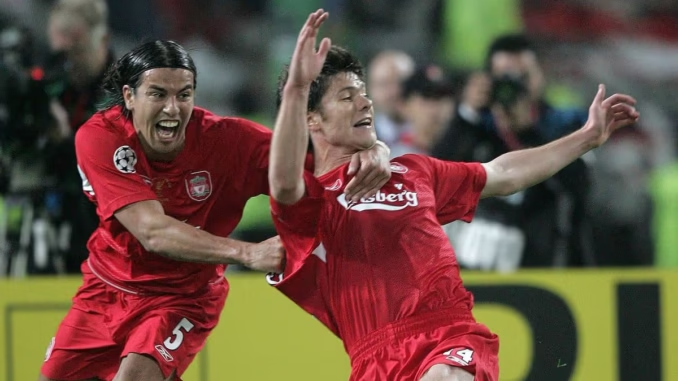
Leaving Liverpool was a Huge Mistake I Should Have Stayed and Fought for My Place”
In football, few decisions carry as much emotional weight as choosing to leave a club like . For many players, Anfield is not just a stadium it is a stage where careers are defined, legacies are built, and dreams either flourish or fade under pressure. Yet football is also a game of difficult choices, and sometimes those choices come back as regret.
This is the reflection of a player who once believed that leaving Liverpool was the right step forward—but now admits it was a mistake. In hindsight, the message is simple and painfully honest: “I should have stayed and fought for my place.”
The Dream That Started at Anfield
For every young footballer, wearing the red shirt of Liverpool is a dream shaped by history. The club’s legacy European nights, dramatic comebacks, and world-class legends creates an environment where only the strongest survive.
Breaking into the first team is never easy. At Liverpool, competition is fierce. Every training session is a battle, every minute on the pitch is earned, not given. Under the demanding standards of modern managers like , players are expected to perform consistently or risk being replaced.
For the player now reflecting on his decision, the early days at Liverpool were filled with hope. There were flashes of promise, moments of brilliance, and the belief that a long-term future at Anfield was possible. But football rarely moves in straight lines.
The Pressure That Changed Everything
As seasons passed, competition for places intensified. New signings arrived. Tactical systems evolved. Injuries, inconsistency, or simply being outperformed meant minutes on the pitch became harder to secure.
In modern elite football, patience is often tested more than talent. At a club like Liverpool, where expectations are relentless and trophies are the minimum requirement, players often feel they must make a decision:
- Stay and fight for limited opportunities
- Or leave to find regular playing time elsewhere
For this player, the second option felt like the safer path at the time. The idea of restarting elsewhere promised more minutes, more freedom, and a fresh environment away from the pressure cooker of Anfield.
But football has a way of revealing truths only after time has passed.
The Departure Decision
When the decision to leave Liverpool was finally made, it came with mixed emotions. On one hand, there was relief an escape from uncertainty and frustration. On the other hand, there was sadness, though it was buried under professional reasoning.
“I needed to play football,” he told himself. “I need to be important somewhere.”
At the time, it sounded logical. Many players have revived their careers after leaving big clubs. The hope was that a new environment would bring confidence and stability.
But what was underestimated was the emotional and psychological value of staying at a club like Liverpool even when things were difficult.
Life After Liverpool: The Reality Check
Initially, the move felt refreshing. New teammates, new system, and a manager who promised opportunity. The first few matches brought optimism. There were starts, assists, maybe even a goal or two.
But football careers are not judged in weeks they are judged in seasons.
Soon, inconsistency crept in. The new system was less familiar than expected. Competition existed everywhere, not just at Liverpool. And slowly, the same problem returned: fighting for a place.
What made it harder was the realization that leaving Liverpool did not remove pressure it simply changed its shape.
Watching Liverpool from the Outside
Perhaps the most painful part of the decision was watching Liverpool continue to evolve without him.
The team kept growing, adapting, and competing at the highest level in England and Europe. The atmosphere at Anfield remained electric. New players stepped up, filling roles that once felt within reach.
There is a unique kind of regret that comes not from failure, but from watching something you were once part of continue without you.
Every big match, every European night, every title race brings a thought:
“That could have been me.”
The Lesson of Competition
In elite football, leaving a big club does not always mean escaping difficulty. Sometimes it means leaving the most valuable environment for growth.
At Liverpool, every training session is an education. Players learn from world-class teammates, elite coaching structures, and a winning mentality that is hard to replicate elsewhere.
Staying would have meant:
- Learning under pressure
- Competing against top players daily
- Growing through adversity
- Waiting for the right moment
Instead, leaving meant starting over in a system that, while different, did not offer the same long-term development structure.
The Emotional Weight of Regret
Regret in football is not always loud. It is often quiet.
It appears in moments of reflection:
- After a missed matchday squad
- After a difficult training session
- After seeing former teammates succeed
The phrase “I should have stayed and fought for my place” is not just about football—it is about belief. Belief in one’s ability to survive competition at the highest level.
For many players, the biggest opponent is not the coach or the system it is doubt.
What Staying Might Have Looked Like
Had the decision been different, the path might have been more challenging but potentially more rewarding.
Staying at Liverpool could have meant:
- Limited early playing time
- Occasional frustration
- Moments of being overlooked
But also:
- Opportunities in big matches due to rotation
- Chances in cup competitions
- Growth under elite tactical systems
- A possible breakthrough moment that changes everything
Football history is full of players who stayed, fought, and eventually became key figures after periods of uncertainty.
The Reality of Modern Football Careers
Modern football is fast, unforgiving, and constantly evolving. Players are judged quickly, and patience is rare on both sides clubs and athletes.
The decision to leave a club like Liverpool is never simple. It is influenced by:
- Playing time expectations
- Career ambitions
- Financial considerations
- Personal confidence
- Managerial trust
But hindsight often simplifies what was once complicated.
Coming to Terms With the Decision
Despite the regret, this story is not only about loss it is also about understanding.
Every career has defining moments, and this was one of them. The realization now is not just that leaving was a mistake, but that the mentality needed at elite clubs is different: survival through competition.
“I thought I needed to leave to grow,” the reflection goes. “But I didn’t realize growth was already happening where I was.”
Advice to Young Players
From this experience, a few lessons emerge for young footballers facing similar decisions:
- Don’t rush exits from big clubs
Competition is not rejection it is development. - Patience can be more valuable than playing time elsewhere
Sometimes waiting leads to bigger opportunities. - Environment matters more than minutes in the short term
Training with elite players accelerates growth. - Believe in internal breakthroughs
Many careers are built on second or third chances.
Final Reflection
Leaving was supposed to be a step forward. Instead, it became a turning point filled with reflection and regret.
“I should have stayed and fought for my place” is more than a sentence it is a lesson written through experience. Football does not always reward early exits. Sometimes, the hardest path the one filled with competition, patience, and resilience is the one that leads to greatness.
And in hindsight, that is exactly the path that was missed.
Leave a Reply