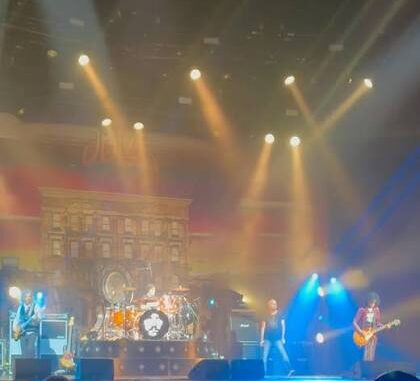
Long before Toronto became one of North America’s most important music cities, a remarkable building at the corner of Yonge Street and Davenport Road was quietly becoming one of its most fascinating cultural landmarks.
Today, the building at 888 Yonge Street is best known as The Concert Hall, but its story is far bigger than any single name. Over more than a century, it has been a Masonic Temple, a ballroom, a community gathering place, Club 888, the legendary Rock Pile, a television studio and, once again, a concert and event space.
And somewhere in that extraordinary history are two names that could hardly be more different: Frank Sinatra and Led Zeppelin.
Sinatra belonged to the golden age of traditional pop, jazz and big-band entertainment. Led Zeppelin represented something entirely different: the explosive arrival of hard rock and the sound of a generation determined to turn the volume all the way up.
Yet both are connected to the same Toronto building.
That unlikely connection is precisely what makes 888 Yonge Street so special. It is not merely an old building that happened to host famous performers. It is a physical record of how Toronto’s culture changed—from elegant ballrooms and orchestras to rock ‘n’ roll, psychedelic music, television, broadcasting and the modern live-entertainment industry.
The building’s history reaches back to the First World War, but its musical mythology truly exploded during the 1960s. When Led Zeppelin arrived there in 1969, the group was still emerging from the underground. Within months, it would become one of the biggest rock acts on the planet.
That makes the venue’s history more than nostalgia.
It is a story about a city, a changing music industry and the rare buildings that survive long enough to witness several generations of cultural history.
A Building Born More Than a Century Ago
The story begins in 1917.
The Masonic Temple was constructed at 888 Yonge Street for Toronto’s Masonic organizations, with the building officially opening in January 1918. The complex was designed not simply as a private meeting place but as a substantial multi-purpose building, with the main event space available for rental. That rental function helped offset the costs of operating the Temple.
That decision would ultimately have enormous consequences for Toronto’s musical history.
The building’s main hall could accommodate audiences for concerts, dances, lectures and other events. It possessed a stage, dressing rooms and other facilities that made it suitable for entertainment.
In other words, the seeds of the future concert venue were planted into the building from the beginning.
At first, nobody could have predicted that decades later its walls would vibrate to the sound of Jimmy Page’s guitar or that one of America’s most famous entertainers would use the building for private celebrations.
But the architecture was ready.
The building simply needed the culture around it to change.
From Masonic Temple to Toronto Entertainment Landmark
During its early decades, the building served its original Masonic purpose while its event spaces welcomed the public.
By the 1930s, the ballroom had become an important entertainment destination. The hall was associated with dances, big-band performances and major social occasions. According to Toronto historical accounts, performers including Bing Crosby and Frank Sinatra became part of its story. Sinatra used the space for private parties during the 1950s.
That detail is particularly fascinating.
Sinatra was not simply another name on a concert poster.
His connection to the building belongs to a different era of entertainment—one in which celebrity, elegance and live orchestral music dominated the cultural landscape.
The hall had already established itself as a place where people gathered for music and celebration.
Then rock ‘n’ roll arrived.
And everything began to change.
The Birth of the Rock Pile
By the 1960s, Toronto was experiencing a musical transformation.
The city’s Yonge Street area had become an important centre for live music, with clubs and venues attracting performers from Canada, the United States and Britain. Toronto Metropolitan University’s archives describe Yonge Street during the 1960s and 1970s as a major destination for rhythm and blues, jazz, rock ‘n’ roll, folk and other forms of popular music.
The old Masonic Temple was perfectly positioned to become part of that transformation.
It acquired new identities, including Club 888, before becoming known as the Rock Pile during the late 1960s.
The name alone tells you almost everything about the change.
The building that had once welcomed formal gatherings and ballroom entertainment was now becoming a home for a younger, louder and more rebellious audience.
The Rock Pile became associated with the emerging rock culture that was sweeping across North America.
Artists who would become major names passed through its doors.
And in February 1969, a young British band called Led Zeppelin arrived.
The Night Led Zeppelin Came to Toronto
Led Zeppelin’s first Toronto performance at the venue took place on February 2, 1969, according to the band’s official concert archive.
This was an extraordinary moment in hindsight.
Today, Led Zeppelin is recognized as one of the most influential rock bands in history. Jimmy Page, Robert Plant, John Paul Jones and John Bonham became symbols of the power and ambition of 1970s rock.
But in early 1969, the story was still being written.
The band’s debut album had only recently arrived, and its reputation was spreading rapidly.
Toronto was one of the places where audiences could experience that transformation up close.
The band’s appearance at the Rock Pile was not a massive arena spectacle. It was something much more intimate.
That intimacy is part of what makes the performance legendary.
The venue was considerably smaller than the giant arenas where Led Zeppelin would later perform. Fans were close to the musicians. The sound was physical. The audience was discovering a band that was still developing its identity.
And Led Zeppelin were not simply playing polished versions of familiar radio hits.
They were stretching songs.
They were improvising.
They were experimenting with volume, dynamics and extended instrumental passages.
They were creating the language that would soon become synonymous with hard rock.
Led Zeppelin Returned—and Everything Had Changed
Perhaps the most remarkable part of the story is that Led Zeppelin returned to the same venue later that year.
On August 18, 1969, the band played two shows at the Rock Pile, one at 8 p.m. and another at 11:30 p.m. The official Led Zeppelin archive records both performances.
But the band that returned in August was not quite the same band that had arrived in February.
Its popularity had exploded.
The August shows sold out in advance, while the venue’s management reported that at least 2,000 people were turned away. The official Led Zeppelin archive’s contemporary review described the concert as one of Toronto’s most significant pop events of the year.
Think about that transformation.
In February, Toronto audiences were getting an early look at a powerful new British group.
By August, demand had become so intense that thousands of people could not get inside.
That is one of the most compelling chapters in the history of the Rock Pile.
The venue became a kind of laboratory for Led Zeppelin’s rise.
Fans who attended could say they had seen the group before it became a stadium phenomenon.
They were not watching history from a distance.
They were standing inside it.
A Night That Helped Define Heavy Rock
The atmosphere surrounding Led Zeppelin’s August performance has become part of Toronto music folklore.
The band’s official archive preserves a contemporary review describing the two shows as completely sold out and emphasizing the extraordinary excitement surrounding the group.
The performances included songs such as “Train Kept A-Rollin’,” “I Can’t Quit You Baby,” “Dazed and Confused,” “You Shook Me” and “How Many More Times.”
These were not the stadium anthems that future generations would know.
There was no established mythology surrounding “Stairway to Heaven.”
There was no expectation that the four musicians would eventually become rock legends.
Instead, the audience was witnessing a band building its reputation in real time.
That makes the Rock Pile shows particularly valuable to music history.
They capture Led Zeppelin at a crucial point between obscurity and superstardom.
The Venue’s Small Size Was Part of the Magic
One of the great ironies of Led Zeppelin’s history is that the band would eventually become famous for enormous concerts.
The group would perform in massive arenas and stadiums, surrounded by thousands of fans.
But their early Toronto appearances happened in a much smaller environment.
That created an atmosphere that could never be completely reproduced later.
At the Rock Pile, fans were close enough to see Jimmy Page’s technique, Robert Plant’s physical intensity, John Bonham’s extraordinary drumming and John Paul Jones’ musicianship without the gigantic production machinery that would later become part of Led Zeppelin’s identity.
The building itself contributed to the experience.
The current Concert Hall describes the space as featuring a raised stage, ornate proscenium arch, hardwood floor and distinctive acoustics.
Those details matter.
A concert venue is never simply four walls.
The size of the room, the shape of the ceiling, the materials used in construction and the distance between performers and audience all influence the atmosphere.
At 888 Yonge, the architecture became part of the music.
Frank Sinatra and Led Zeppelin: An Unlikely Pair
The Sinatra connection makes the story even more extraordinary.
On one side is Frank Sinatra, a defining figure of 20th-century popular music.
On the other is Led Zeppelin, a band that helped redefine rock music.
Their musical styles were worlds apart.
Sinatra’s performances were associated with sophisticated arrangements, jazz phrasing, orchestras, tuxedos and the Great American Songbook.
Led Zeppelin represented a new era of amplified guitar, blues-based experimentation, extended improvisation and rock spectacle.
Yet both belong to the story of this building.
Sinatra’s private parties in the hall connect it to Toronto’s glamorous mid-century entertainment scene. Led Zeppelin’s concerts connect it to the city’s late-1960s counterculture and rock revolution.
The building therefore becomes something much more interesting than a “rock venue.”
It is a meeting point between generations.
When the Rock Pile Became a Cultural Symbol
The Rock Pile’s reputation grew rapidly.
The venue hosted a remarkable list of artists during the late 1960s, including performers from blues, soul, rock and psychedelic music. Contemporary and historical accounts associate the building with artists such as Tina Turner, Muddy Waters, Chuck Berry, B.B. King, The Who, Frank Zappa and the Grateful Dead.
That diversity is important.
The Rock Pile did not represent one specific genre.
It represented a moment when the boundaries between musical styles were becoming increasingly fluid.
Blues musicians influenced rock musicians.
British performers rediscovered American blues.
Young audiences embraced louder guitars.
Traditional pop stars continued to command enormous respect.
And venues like the Rock Pile gave these different worlds somewhere to intersect.
The Rolling Stones Connection
Led Zeppelin was not the only legendary British rock act connected to 888 Yonge Street.
The Rolling Stones also used the space as a rehearsal venue, reportedly returning to it as a summer rehearsal location before tours.
That adds another layer to the building’s mythology.
Imagine walking through the same building and knowing that musicians from some of the most important British rock bands of all time had rehearsed there.
The walls were not merely exposed to finished performances.
They were exposed to the creative process.
Rehearsals are where songs are tested, arrangements are changed and musicians work out how a performance will function in front of an audience.
The building therefore became part of the behind-the-scenes history of rock music as well as its public history.
The Rock Pile’s Difficult Side
The story is not entirely romantic.
The venue’s success also created serious problems.
The 1969 Led Zeppelin concerts were part of a period in which the Rock Pile’s finances became increasingly difficult. A York University historical account says that the venue’s troubles intensified following the August 1969 Led Zeppelin appearance and that the Rock Pile subsequently closed.
This is an important reminder that cultural history is rarely simple.
A venue can become legendary without becoming financially sustainable.
The same popularity that creates unforgettable memories can also increase operating costs, create conflicts with owners or neighbours and make the economics of live music increasingly difficult.
The Rock Pile’s story therefore reflects a larger truth about music venues.
They are often fragile.
A room can become culturally priceless while remaining financially vulnerable.
The Building Refused to Disappear
What happened next makes the story even more remarkable.
The building went through multiple identities.
It was no longer permanently defined by one musical era.
It became associated with different forms of entertainment and broadcasting, including television production. In the 1990s, it was used by CTV, and later it became associated with MTV Canada.
But through all those transformations, the historic structure remained.
That is significant because Toronto has changed dramatically over the past century.
Buildings have been demolished.
Neighbourhoods have been redeveloped.
Music venues have disappeared.
Entire eras of entertainment have faded.
Yet 888 Yonge Street survived.
The Threat of Demolition
Perhaps the most dramatic chapter in the building’s modern history came when its future was uncertain.
The property was threatened with demolition in the 1990s, but heritage protection helped save it. The Led Zeppelin official archive notes that the building was added to Toronto’s Inventory of Heritage Properties in 1974 and designated under the Ontario Heritage Act in 1997.
That decision now looks enormously important.
Without it, the physical place where Led Zeppelin made its early Toronto history—and where Sinatra had once hosted private events—could have disappeared beneath a new development.
The music would have survived.
The recordings would have survived.
The photographs and memories would have survived.
But the building itself would have been gone.
Heritage preservation prevented that.
Why Physical Places Matter in Music History
In an age when almost every concert can be photographed, recorded or shared online, it can be easy to underestimate the importance of physical venues.
But music history is deeply connected to places.
A song can be heard anywhere.
A record can be played anywhere.
A performance, however, happens somewhere.
That “somewhere” becomes part of the memory.
For the people who attended Led Zeppelin’s 1969 Toronto performances, the experience was not simply hearing songs.
It was being inside the Rock Pile.
They remember the room.
They remember the crowd.
They remember the volume.
They remember the anticipation.
They remember what it felt like to watch a band that had not yet become the institution it would later become.
That is something a streaming service cannot reproduce.
The Architecture Is Part of the Story
The building’s physical character is another reason it remains significant.
The Concert Hall retains historic features including its stage, proscenium arch and hardwood floor.
Those details create a fascinating contrast.
The exterior and much of the building’s structure belong to an earlier Toronto.
Inside, however, generations of performers transformed the space.
A formal hall became a rock club.
A Masonic meeting place became a cultural gathering point.
A television studio occupied the building.
And eventually the concert identity returned.
Few places can tell that many stories without being completely erased and rebuilt.
A Bridge Between Old Toronto and New Toronto
Perhaps the best way to understand 888 Yonge Street is as a bridge between different versions of Toronto.
There was the Toronto of the early 20th century, when the Masonic Temple was built.
There was the Toronto of the big-band era.
There was the Toronto of Frank Sinatra and ballroom entertainment.
There was the Toronto of 1960s counterculture.
There was the Toronto that welcomed Led Zeppelin.
There was the Toronto of television and broadcasting.
And there is today’s Toronto, where historic buildings exist alongside modern towers, technology companies, restaurants, apartments and new entertainment spaces.
The building has experienced all of those transformations.
Why Led Zeppelin’s Toronto Story Still Matters
Led Zeppelin’s first Toronto show at the Rock Pile is important because it happened at a turning point.
The band was already talented.
It was already ambitious.
But its future was not guaranteed.
The February 1969 performance occurred only weeks after the group’s debut album was released in the United Kingdom and North America. By August, the band had grown dramatically in popularity, with its Toronto return attracting enormous attention.
That six-month period captures something extraordinary about popular music.
Superstardom can sometimes happen faster than anyone expects.
A band can go from being an exciting new act to a cultural phenomenon in a matter of months.
The Rock Pile happened to be there at exactly the right moment.
Toronto Was Ready for the Revolution
The city’s music culture also deserves credit.
Toronto was not merely a stop on an American tour.
It had its own audience hungry for new sounds.
The city’s Yonge Street music scene was becoming increasingly influential, and venues across the area provided spaces for emerging musicians and international stars.
The Rock Pile was part of that ecosystem.
Its importance came from the relationship between the room, the performers and the audience.
Without an audience willing to embrace new music, a venue cannot become legendary.
Toronto supplied that audience.
More Than a Led Zeppelin Venue
It would be tempting to define 888 Yonge Street entirely through Led Zeppelin.
After all, the band’s first Toronto appearance there is one of the most exciting chapters in the building’s history.
But that would sell the venue short.
It was important before Led Zeppelin.
It remained important after Led Zeppelin.
And its significance comes from the extraordinary range of artists and cultural movements associated with it.
Frank Sinatra.
Led Zeppelin.
The Rolling Stones.
Tina Turner.
The Who.
David Bowie.
The Grateful Dead.
B.B. King.
Those names represent completely different generations and musical traditions.
The fact that they all intersect with the same building is what makes the venue extraordinary.
The Sinatra Connection Gives the Building Another Dimension
The Frank Sinatra story is particularly useful because it prevents the venue from being remembered only as a rock institution.
Sinatra’s association with private parties at the building during the 1950s places 888 Yonge Street firmly within Toronto’s earlier entertainment culture.
This means the building witnessed the transition from one kind of celebrity culture to another.
In Sinatra’s era, entertainment was often built around elegance, live orchestras and formal social occasions.
By Led Zeppelin’s era, the atmosphere was different.
The audience was younger.
The music was louder.
The cultural expectations were changing.
But the building remained.
That continuity is what gives its story such depth.
The Meaning of a “Legendary Venue”
A legendary venue is not necessarily the biggest.
It is not necessarily the newest.
And it does not need to host thousands of people every night.
Sometimes a venue becomes legendary because of what happened there at exactly the right moment.
The Rock Pile was comparatively intimate.
But the artists who passed through its doors became enormous.
That created a powerful contrast.
A relatively small room became associated with some of the biggest names in music.
In that sense, the building’s legend is not about size.
It is about significance.
The Sound of a Generation
When Led Zeppelin played the Rock Pile, rock music was undergoing a dramatic transformation.
Blues-based guitar music was becoming heavier.
Concerts were becoming more important.
Albums were becoming artistic statements rather than simply collections of singles.
Musicians were gaining greater freedom to experiment on stage.
Audiences were demanding more from live performances.
Led Zeppelin stood at the centre of that transformation.
And the Rock Pile gave them an environment in which that transformation could be experienced at close range.
The venue was therefore part of a much bigger cultural shift.
The Importance of Memory
For those who were there, the building’s significance is deeply personal.
The official Led Zeppelin archive contains numerous recollections from people who attended the band’s Toronto performances. Some describe the concerts as unforgettable experiences decades later.
That is perhaps the strongest evidence of all.
A building survives through bricks and mortar.
A venue becomes legendary through memory.
The people who attended the shows carry those experiences forward.
They tell their children.
They tell friends.
They write about them.
They preserve tickets and photographs.
They remember what the room sounded like.
And eventually those memories become part of the history of the city itself.
Why 888 Yonge Street Still Matters Today
The building’s modern importance is not simply about nostalgia.
It represents the value of preserving cultural spaces.
Toronto continues to evolve rapidly.
New venues appear.
Old venues disappear.
Music scenes move from one neighbourhood to another.
But historic buildings can provide something that new construction cannot manufacture: authenticity.
You cannot build a new 888 Yonge Street and recreate its history.
You can copy the architecture.
You can reproduce the lighting.
You can install an impressive sound system.
But you cannot recreate the fact that Led Zeppelin stood on that stage in 1969.
You cannot recreate Sinatra’s presence in the building decades earlier.
History cannot be manufactured.
It has to happen.
A Venue That Survived Every Era
The remarkable thing about 888 Yonge Street is that it has repeatedly reinvented itself without losing its historical identity.
It began as the Masonic Temple.
It became an entertainment space.
It became Club 888.
It became the Rock Pile.
It returned to being known as the Concert Hall.
It became associated with television and broadcasting.
And it has continued to retain its cultural and architectural significance.
Most buildings do not survive that many transformations.
Fewer still remain meaningful through every one.
The Venue’s Greatest Legacy
Perhaps the greatest legacy of the building is not any particular concert.
It is the fact that it provided a stage for change.
Frank Sinatra represented one generation.
Led Zeppelin represented another.
The Rolling Stones represented another dimension of rock culture.
Television brought another audience into the building.
Modern events continue the process.
The building has always adapted to the culture surrounding it.
That may be why it still matters.
It did not freeze itself in 1918.
It did not become trapped in the 1950s.
It did not disappear after the Rock Pile era.
It kept changing.
Imagine the Walls Could Talk
If the walls of 888 Yonge Street could speak, the stories would be extraordinary.
They could describe elegant ballroom events from decades ago.
They could recall Sinatra’s private parties.
They could remember the arrival of a young British band called Led Zeppelin.
They could tell the story of the crowds outside the Rock Pile.
They could describe Jimmy Page playing guitar in an intimate Toronto room before the band became a global phenomenon.
They could remember the Rolling Stones rehearsing.
They could recall the transition from live music to television.
And they could describe the countless people who passed through the building without realizing they were standing inside a piece of cultural history.
That is what makes historic venues so powerful.
They contain layers.
The Toronto Connection
The story also says something about Toronto itself.
Toronto has long been a city where different cultures, musical traditions and generations intersect.
Its music history includes jazz clubs, blues bars, rock venues, concert halls, theatres and enormous arenas.
But places such as 888 Yonge Street show that the city’s musical identity was not built exclusively inside giant modern stadiums.
It was built in rooms.
Small rooms.
Old rooms.
Unlikely rooms.
Rooms that sometimes looked ordinary from the outside but became extraordinary because of what happened inside.
From 1969 to Today
More than half a century has passed since Led Zeppelin first played at the Rock Pile.
The music industry has changed beyond recognition.
Records became CDs.
CDs became downloads.
Downloads became streaming.
Concert production became bigger and more technologically advanced.
Yet the basic attraction of a live music venue has remained the same.
People still want to stand in a room with other people and watch musicians perform.
That is the connection between Sinatra’s era, Led Zeppelin’s era and today’s music world.
Technology changes.
The desire for live experience does not.
Why Preserving the Venue Was So Important
The fact that the building survived a serious threat of demolition is one of the most important parts of the story.
Had it disappeared, Toronto would have lost more than an old building.
It would have lost a physical connection to multiple generations of music history.
Heritage designation ensured that the structure could continue to exist as part of Toronto’s cultural landscape.
That decision demonstrates why heritage preservation matters.
History is not always found in museums.
Sometimes it is standing on a busy street corner.
Sometimes it is hidden behind an ordinary door.
Sometimes it is a concert hall that has changed names several times.
And sometimes it is a place where Frank Sinatra and Led Zeppelin somehow became part of the same story.
The Real Reason It Still Matters
So why does this legendary Toronto venue still matter?
Because it represents something increasingly rare.
It is a physical link between generations.
It connects Toronto’s early 20th-century history with its modern cultural identity.
It connects ballroom entertainment with rock ‘n’ roll.
It connects Frank Sinatra with Led Zeppelin.
It connects established stars with young musicians who had not yet become legends.
And most importantly, it demonstrates that cultural history is often created in unexpected places.
When Led Zeppelin walked onto the Rock Pile stage in 1969, nobody could know exactly how important that moment would become.
When Sinatra used the building for private events years earlier, nobody could have predicted that future generations would still be talking about the place.
That is the nature of history.
People experience it before they understand it.
A Toronto Landmark That Refuses to Fade
The story of 888 Yonge Street is ultimately a story about survival.
The building survived changing musical tastes.
It survived changing audiences.
It survived changing owners and identities.
It survived the decline of the Rock Pile.
It survived the transformation of Toronto’s entertainment industry.
It survived threats to its physical existence.
And it survived long enough for a new generation to rediscover its importance.
Today, its name may not carry the same instant recognition as Madison Square Garden or the Hollywood Bowl.
But its history is every bit as fascinating.
Few places can claim such an extraordinary combination of music, architecture and cultural transformation.
Few can say that Frank Sinatra’s world and Led Zeppelin’s world both passed through their doors.
And fewer still can say that they survived to tell the story.
Final Thoughts
There are famous venues, and then there are venues that become part of the mythology of an entire city.
888 Yonge Street belongs in the second category.
Its story began with the Masonic Temple more than a century ago. It became a ballroom and gathering place, welcomed stars such as Frank Sinatra, transformed into Club 888 and the Rock Pile, and then became one of the places where Toronto experienced the explosion of late-1960s rock music.
Led Zeppelin’s 1969 appearances are undoubtedly among its most important chapters. The band’s first Toronto performance came when its future was still uncertain; its return later that year came after its popularity had exploded.
That transformation is now legendary.
But the building’s importance goes beyond one band.
It tells the story of Toronto itself.
It reminds us that great music does not exist independently of place. Songs, performances and artists become memories because they happened somewhere—and sometimes that somewhere survives.
At 888 Yonge Street, generations of music history collided under one roof.
Frank Sinatra represented the elegance of one era.
Led Zeppelin represented the rebellion of another.
The Rolling Stones, Tina Turner, The Who, David Bowie and countless others added their own chapters.
And the building remained standing through it all.
That is why it still matters.
Because long after the final note has faded, the room remains.
And sometimes, a room can tell the story of an entire generation.
Leave a Reply