The world of rock music has spent decades celebrating the musicians who stood beneath the lights, but behind every legendary performer there are often people whose names never appeared on album covers or concert posters. They were the craftspeople, friends, advisers and local figures who helped shape the lives and image of the stars.
Peter Robinson was one of those people.
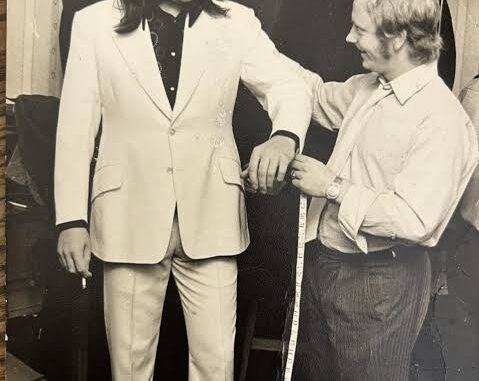
The Redditch tailor, remembered for making suits for his school friend John Bonham, has become the subject of renewed tributes from those who remember his connection to one of rock music’s greatest drummers. Bonham, the powerful drummer of Led Zeppelin, was born in Redditch, Worcestershire, and his connection to his hometown remained an important part of his story even after international fame transformed his life.
For fans of Led Zeppelin, the story offers something different from the familiar tales of sold-out arenas, huge recording sessions and legendary performances. It is a reminder that before John Bonham became “Bonzo,” the thunderous drummer admired around the world, he was simply a young man growing up in Redditch and surrounded by people who knew him before fame arrived.
Among those people was Peter Robinson.
A friendship that began before Led Zeppelin
John Bonham’s rise to international fame can sometimes make it easy to forget how ordinary his beginnings were.
Born in Redditch, Bonham developed his reputation as a drummer during the British rock explosion of the 1960s. Before joining Led Zeppelin, he was part of the Midlands music scene and played with Robert Plant in the Band of Joy. That early musical connection eventually became significant when Jimmy Page was forming the group that would become Led Zeppelin.
But Bonham’s story was not only about music.
Like many people who become famous, he had a life before celebrity. He had friends, family, a hometown and people who knew him without the mythology that later surrounded his name.
Peter Robinson belonged to that earlier chapter.
The two were school friends, and Robinson later became known for making suits for Bonham. A family tribute reported by the Redditch Standard recalled Robinson’s connection with the drummer and his work as the tailor responsible for Bonham’s suits.
That seemingly simple detail carries considerable significance.
Clothing was an important part of the visual language of rock music in the late 1960s and 1970s. Musicians did not simply perform songs; their appearance became part of their identity. Suits, jackets, boots, shirts and other pieces of clothing could become instantly associated with particular artists.
For Bonham, whose physical presence behind the drums became one of the defining images of Led Zeppelin, the clothes he wore were part of that wider image.
And behind some of those clothes was a tailor who had known him long before the world did.
From Redditch to the world stage
The contrast between Bonham’s hometown roots and his eventual international fame is one of the most fascinating parts of his story.
Led Zeppelin became one of the most influential rock bands in history. Jimmy Page, Robert Plant, John Paul Jones and John Bonham created a sound that combined blues, hard rock, folk influences and improvisation.
At the centre of that sound was Bonham’s drumming.
His playing was powerful without being merely loud. He combined enormous bass-drum impact with swing, groove and remarkable control. Songs such as “Good Times Bad Times,” “Whole Lotta Love,” “Immigrant Song,” “When the Levee Breaks” and “Kashmir” demonstrated different aspects of his musicianship.
The drummer’s reputation grew rapidly.
Yet the people who had known him before Led Zeppelin continued to see another side of him.
That is what makes the story of Peter Robinson so compelling.
Robinson did not become famous because he was part of Led Zeppelin’s official lineup. He was not a manager, producer or record executive. Instead, his connection was personal and local.
He knew John Bonham as John.
That distinction matters.
The tailor behind the suits
The relationship between a musician and a tailor can appear insignificant when compared with recording contracts or international tours. But bespoke clothing involves something more personal than simply purchasing an outfit from a shop.
A tailor works with measurements, materials, cuts and individual preferences. The goal is to create something specifically for one person.
For a musician developing a public identity, that personal relationship can become particularly meaningful.
Bonham’s stage presence was enormous. He was physically energetic, charismatic and unmistakable behind his drum kit. His clothing formed part of that presence.
The fact that some of his suits were made by someone he had known since school gives those garments an additional historical dimension.
They were not simply pieces of clothing.
They represented a connection between Bonham’s ordinary life and his extraordinary career.
The suits were made by someone from home, someone who knew the man before he became a global rock star.
Why Peter Robinson’s story matters to Led Zeppelin fans
Led Zeppelin’s history has been documented extensively.
There are countless books, interviews, photographs, documentaries and recordings devoted to the group. Fans have spent decades examining performances, equipment, recording techniques, tours and individual songs.
But stories like Robinson’s provide another perspective.
They bring the story back down to a human level.
Instead of seeing Bonham only as the drummer responsible for some of rock’s most celebrated performances, fans can remember that he was also a young man from Worcestershire who had friendships and relationships outside the music industry.
That local connection is especially important because Redditch remains closely associated with Bonham.
His hometown has continued to remember him, and Parliament has also highlighted Redditch’s connection to the drummer as part of the town’s cultural heritage.
Peter Robinson’s story therefore fits into a larger picture: the relationship between a world-famous musician and the community that knew him before fame.
The importance of remembering the people behind the stars
The music industry often focuses on performers.
Fans know the names of singers, guitarists, drummers and songwriters. They recognize album covers and concert photographs. They remember chart positions and famous performances.
But careers are rarely built by one person alone.
Behind an artist there may be tailors, photographers, technicians, roadies, instrument makers, friends, family members, teachers and countless others.
Some influence an artist’s career directly.
Others simply provide a connection to normal life.
People such as Peter Robinson remind us that the history of rock music exists outside recording studios and concert venues.
A tailor can become part of that history simply by making clothes for a musician.
A school friend can become part of rock history simply by remaining connected to someone who later becomes famous.
A hometown can become part of musical mythology because one of its sons changes the course of popular music.
John Bonham’s extraordinary legacy
To understand why a tribute to someone connected with Bonham attracts attention, it is necessary to understand the extraordinary legacy of the drummer himself.
John Bonham died on September 25, 1980, at the age of 32. His death marked a devastating turning point for Led Zeppelin.
The surviving members ultimately decided that they could not continue the band without him. A Vanity Fair account of Led Zeppelin’s history notes that Bonham’s death left a profound hole in the group and that the surviving members did not believe Zeppelin could continue in the same way without him.
That decision helped preserve the mythology surrounding the original band.
Bonham was not replaced.
His position in Led Zeppelin remained uniquely his.
More than four decades later, his influence can still be heard in rock drumming. Musicians continue to study his grooves, his bass-drum patterns, his fills and his approach to dynamics.
He became one of the benchmarks against which rock drummers are measured.
Yet the story of his life did not begin with Led Zeppelin.
It began in Redditch.
From school friend to rock legend
That is where Peter Robinson’s connection becomes especially poignant.
When Robinson made suits for Bonham, he was not dressing an abstract rock icon. He was dressing someone he had known as a school friend.
The world would eventually know Bonham as one of the most important drummers in popular music.
Robinson knew the person who existed before the fame.
That difference is difficult for later generations to fully appreciate.
Imagine knowing someone before they performed in front of thousands of people. Imagine seeing them as a teenager or young musician before their name became recognized around the world.
Then imagine watching that same person become part of one of the most famous bands in history.
For Robinson and others from Bonham’s hometown, Led Zeppelin’s success would have been both astonishing and deeply personal.
A connection preserved through clothing
One of the most fascinating aspects of this story is that clothing can preserve history.
A recording can preserve a musician’s sound.
A photograph can preserve a moment.
A concert ticket can preserve evidence that an audience was there.
But a suit can preserve something different: the physical connection between a person and the period in which they lived.
When a suit worn by a famous musician survives, it can become a historical object.
It carries information about style, measurements, materials and the individual’s personal preferences.
In Bonham’s case, the story becomes even more meaningful because the tailor had a personal connection with him.
Reports about one of Bonham’s suits have previously drawn attention from collectors and the public, demonstrating the continuing fascination with objects associated with the drummer.
For collectors, such an item is valuable because of its connection to a rock legend.
For people who knew Bonham, however, its meaning can be much more personal.
It represents a friend, a schoolmate and a familiar face from Redditch.
A quieter part of rock history
Rock history is often written around dramatic events.
There are legendary concerts, controversial moments, record-breaking albums and stories of excess.
But quieter stories can sometimes reveal more about the people involved.
The story of Peter Robinson is one of those quieter stories.
There is no need for a dramatic concert anecdote to make the relationship meaningful.
The essential fact is simple: Robinson was a school friend of John Bonham and made suits for him.
That connection places Robinson in a unique position within the story of one of Britain’s most famous musicians.
He was not simply a stranger who happened to make a famous person’s clothes.
He was part of Bonham’s life before and during his transformation into a rock icon.
Tributes reflect more than one man’s life
When people pay tribute to Peter Robinson, they are not simply remembering a tailor.
They are also remembering a period of British cultural history.
The 1960s and 1970s produced a generation of musicians whose influence continues to shape popular music. In the Midlands, musicians such as Bonham and Robert Plant emerged from local communities before becoming international stars.
The fact that people who knew these musicians in their younger years can still be connected to their stories gives rock history a sense of continuity.
Robinson’s story is therefore part of a broader tribute to the people and places that helped shape John Bonham.
Redditch and the Bonham legacy
Redditch has a special place in the history of Led Zeppelin because it was Bonham’s hometown.
The town’s connection to the drummer has been acknowledged publicly as part of its cultural identity.
Bonham’s success transformed him into a global figure, but his roots never disappeared from the story.
The contrast is striking.
On one side was the international Led Zeppelin phenomenon: huge stages, recording studios, worldwide tours and millions of fans.
On the other was Redditch, where Bonham had grown up and where people knew him before the fame.
Peter Robinson represents that second side of the story.
His connection reminds fans that even the biggest rock stars remain connected to ordinary places and ordinary relationships.
The human side of John Bonham
There is a tendency to turn legendary musicians into larger-than-life characters.
Bonham’s reputation as a drummer encourages that.
His playing was explosive. His performances could be overwhelming. His influence became enormous.
But stories about people such as Robinson bring the human being back into focus.
Bonham was somebody’s school friend.
He was somebody’s neighbour.
He was somebody’s son.
And, in Robinson’s case, he was a customer and friend who trusted a tailor to make his clothes.
Those details may seem small, but together they create a more complete picture.
Why fans continue to care decades later
John Bonham died in 1980, yet interest in his life has never disappeared.
New generations continue to discover Led Zeppelin.
Young drummers still study Bonham’s performances.
Classic rock stations continue to play the band’s music.
Collectors continue to seek out memorabilia.
Books and documentaries continue to revisit the band’s history.
And fans remain fascinated by the personal stories surrounding the musicians.
That is why a tribute to someone such as Peter Robinson can resonate decades after Bonham’s death.
The connection is not merely about fashion.
It is about memory.
It is about the people who knew the stars before the rest of the world did.
A legacy stitched into rock history
There is something fitting about a tailor becoming part of the story of a drummer.
A tailor works with rhythm in a different way.
Measurements must be precise. Stitches must be carefully placed. Patterns must come together. A finished suit depends on many small details working together.
Music works similarly.
A Led Zeppelin performance was built from countless details: Jimmy Page’s guitar work, Robert Plant’s voice, John Paul Jones’s bass and keyboards, and John Bonham’s extraordinary drumming.
Every element mattered.
And while Robinson did not create the music, his work helped shape part of the visual world surrounding one of its central figures.
That is the kind of contribution that can easily disappear from conventional histories.
But it deserves to be remembered.
More than a name in the background
Peter Robinson’s story is ultimately about the importance of people who exist just outside the spotlight.
The audience sees the performer.
The camera captures the performer.
The record sleeve celebrates the performer.
But behind that image are countless relationships.
Robinson’s connection with Bonham shows how fame does not erase a person’s past. Instead, it can make that past unexpectedly important.
The school friend who once knew a young John Bonham eventually became part of the story surrounding one of rock’s most celebrated musicians.
His suits became connected to a legend.
His craftsmanship became part of Bonham’s personal history.
And his memory now provides another way for fans to understand the man behind the drums.
Remembering Peter Robinson
Tributes to Peter Robinson therefore deserve to be understood in the context of both his own life and John Bonham’s extraordinary legacy.
He may not have stood on stage with Led Zeppelin.
He may not have recorded an album.
He may not have appeared in the band’s photographs.
But he knew John Bonham before the world knew “Bonzo.”
He helped make the suits that became part of Bonham’s public image.
And, most importantly, he represented the personal world that existed around the drummer before and during his rise to international fame.
That is a legacy worth remembering.
The story that remains
Led Zeppelin’s music continues to echo decades after the band stopped performing together.
Bonham’s drums remain among the most recognizable sounds in rock.
His influence remains enormous.
But the stories surrounding him are just as important in preserving his humanity.
Peter Robinson’s story is one of those stories.
It takes us away from the massive stages and back to Redditch.
Away from the mythology and back to friendship.
Away from the global superstar and back to the young man who once attended school with a local tailor.
That is perhaps why the tributes feel so meaningful.
They are not only about a tailor.
They are about a friendship.
They are about a hometown.
They are about craftsmanship.
And ultimately, they are about remembering the human being behind one of the greatest drummers rock music has ever known.
John Bonham’s legacy will continue through his recordings, his performances and the countless musicians influenced by his playing.
But memories of the people who knew him before fame add another layer to that legacy.
Peter Robinson’s place in that story is a reminder that history is not always made only by the people standing beneath the spotlight.
Sometimes, it is also preserved by the people standing quietly behind them.
Leave a Reply