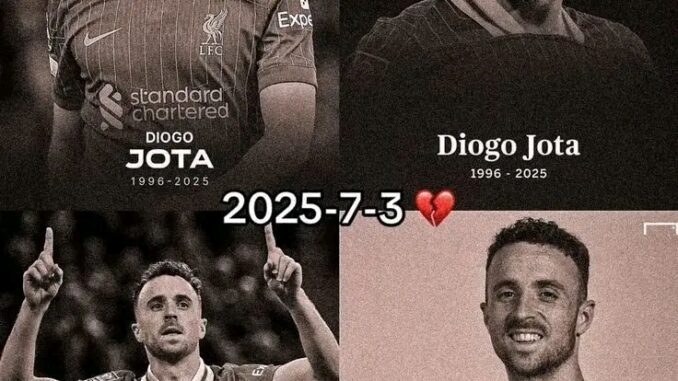
**Liverpool’s Heartfelt Tribute to Diogo Jota Still Touches the Soul of the Fans**
In the sacred stands of Anfield, where echoes of “You’ll Never Walk Alone” have carried generations through triumph and tragedy, a profound silence fell on a warm August evening in 2025. Just weeks after the devastating loss of Diogo Jota and his brother André Silva in a car accident in Spain, Liverpool Football Club and its supporters came together in a display of love, grief, and unbreakable unity. Placards spelling “DJ20” and “AS30” rose in the stands, players linked arms around the centre circle, and the anthem swelled with raw emotion. That moment, and the many that have followed, proved one undeniable truth: Diogo Jota may have left this world at just 28, but his spirit remains etched into the heart of Liverpool FC — and the tributes continue to resonate deeply with fans worldwide.
The tragedy struck on July 3, 2025. Diogo José Teixeira da Silva, known simply as Diogo Jota, and his brother André Silva perished in a road traffic accident in north-western Spain. For a club and city that have endured profound losses — from the Hillsborough disaster to the passing of legends — this news delivered a fresh, unimaginable blow. Jota was not just a talented forward; he was a beloved member of the Liverpool family, a player whose smile, work rate, and iconic heart-shaped goal celebration had won over the Kop.
### From Porto to Anfield: Jota’s Red Journey
Born on December 4, 1996, in Porto, Portugal, Jota rose through the ranks at FC Porto before making a name for himself at Wolverhampton Wanderers. His big move to Liverpool came in September 2020 for around £41 million. Many wondered if the diminutive forward could thrive in Jürgen Klopp’s intense, high-pressing system. He answered those doubts emphatically.
Over five seasons, Jota made 182 appearances and scored 65 goals for the Reds. He played a key role in Liverpool’s Premier League title win in 2024-25, adding an FA Cup and two EFL Cups to his collection. His versatility — capable of playing as a centre-forward, on the left, or even as a second striker — made him invaluable. Crucially, his big-game mentality shone through: memorable strikes against Manchester City, Arsenal, and in European ties endeared him forever to the Anfield faithful.
Off the pitch, Jota was admired for his humility, family values, and quiet leadership. He formed close bonds with teammates like Mohamed Salah, Virgil van Dijk, and Trent Alexander-Arnold. His Portuguese roots connected him with fans from the large Liverpool Portuguese community, while his work ethic bridged divides in the dressing room. When Liverpool lifted the 2024-25 Premier League trophy, Jota was there — arms raised, heart full — living what would tragically become one of his final chapters in red.
### The Tragic Loss and Immediate Outpouring
News of the accident spread like wildfire on that fateful July day. Liverpool FC issued a statement expressing devastation: “an unimaginable loss.” Tributes flooded in from across football. Cristiano Ronaldo, former teammates at Wolves and Portugal, club legends, and rival fans all paused to honour a player taken far too soon alongside his brother.
At the club’s Melwood and AXA training centres, players and staff laid flowers. Fans descended on Anfield, turning the Shankly Gates into a sea of scarves, shirts bearing the number 20, candles, and messages of love. “Forever in our hearts,” “You’ll Never Walk Alone, Diogo,” and “DJ20” became recurring themes. Even Oasis paid tribute during their reunion tour, a testament to Jota’s reach beyond football.
Liverpool’s first public return to the pitch came in a pre-season friendly against Preston North End. Both sets of players, staff, and supporters honoured the brothers with a wreath, black armbands, a minute’s silence, and a moving rendition of YNWA. The emotion was palpable; there were few dry eyes in the stadium.
### The Powerful Anfield Tribute
The most poignant early tribute came on August 15, 2025, for the Premier League opener against Bournemouth — Liverpool’s first competitive match at Anfield since the tragedy. As the teams emerged, fans held up cards creating mosaics spelling “DJ20” and “AS30.” A period of silence was observed, followed by an emotional performance of “You’ll Never Walk Alone” with banners, flags, and scarves waving in tribute.
Manager Arne Slot later described it as “impressive and powerful.” Players stood arm-in-arm, visibly moved. Mohamed Salah, who shared a special bond with Jota, struggled to contain his emotions. In the 20th minute — Jota’s number — the crowd erupted in applause and song once more. It was football at its most human: a sport that unites in joy and consoles in sorrow.
These gestures were not one-offs. Throughout the 2025-26 season, Jota’s presence lingered. His name remained on the squad list in some communications as a mark of respect. The club retired the number 20 shirt across all levels — first team, women, and academy — ensuring it would only ever be worn again by Jota’s children, should they choose to play for Liverpool.
### Permanent Memorials and Lasting Legacy
In late July 2025, Liverpool announced permanent tributes. A sculpture titled “Forever 20” would stand outside Anfield, featuring a flowing heart at its centre — nodding to Jota’s celebration — and revealing the numbers 20 and 30 from different angles. The club expressed deep gratitude for the outpouring of fan tributes at the stadium.
Further honours included a tribute on the 2025-26 kit, social media posts on significant dates (such as what would have been his 29th birthday on December 4, 2025), and moments of reflection before key matches. On the anniversary of his signing, Liverpool shared images of his iconic heart pose, now immortalised in murals and memories.
These acts reflect Liverpool’s ethos: a club that treats its players as family. From Bill Shankly’s famous words to the modern era under Fenway Sports Group, the institution understands that legacies transcend statistics. Jota’s story — of a boy from Porto who became a Kop hero — embodies the meritocracy and passion that define the club.
### Why These Tributes Resonate So Deeply
Football fans are often accused of fleeting loyalty, but Liverpool supporters have shown otherwise. The continued emotional response to Jota’s tributes stems from several factors:
– **Timing and Shock**: Jota was in his prime, coming off a title-winning season, with years ahead of him. The suddenness amplified the grief.
– **Relatability**: Jota represented the “everyman” star — not the most flamboyant, but relentlessly effective, humble, and committed. Fans saw themselves in his journey.
– **Brotherhood**: Losing both Diogo and André together deepened the tragedy, reminding everyone of the fragility of family bonds.
– **Club Identity**: Liverpool’s history of resilience in the face of adversity (Heysel, Hillsborough, the 1989 FA Cup semi-final) means the community knows how to mourn collectively while celebrating life.
Psychologists and sports sociologists often note that shared grief strengthens group identity. For Liverpool fans scattered globally — from Merseyside to Melbourne — singing for Jota provides catharsis and connection. Social media amplifies this: videos of the Anfield mosaics and YNWA renditions have millions of views, allowing distant supporters to feel part of the moment.
Teammates’ tributes reveal the personal impact. One player stated, “You will stay with us forever.” Arne Slot integrated Jota’s memory into team talks, emphasising the “why” behind their performances — playing for lost brothers, for the badge, for the fans who hurt too.
### The 2025-26 Season: Playing With Heavy Hearts
The season following Jota’s passing tested Liverpool. Without his goals and energy, the attack needed reinvention. New signings paid their respects, wearing black armbands or placing flowers at memorials. Yet, the squad spoke of an extra motivation: honouring Jota by competing at the highest level.
Matches frequently featured 20th-minute applause. Opposing fans, even in heated rivalries, often joined in moments of respect. This universality of football’s mourning process underscores its power as a global unifier.
Off the field, the Jota family has been supported by the club, including gestures like paying out his contract — a classy move beyond contractual obligation. Such actions reinforce why Liverpool holds a special place in many hearts.
### A Legacy Beyond the Pitch
Diogo Jota’s story is one of talent realised, joy given, and life cut short. His iconic heart celebration now symbolises not just goals, but love for the game, club, and family. Children at Liverpool’s academy wear shirts remembering him. Murals in the city and beyond depict his smile.
For fans, the tributes touch the soul because they affirm that football is more than business or entertainment. It is community, memory, and emotion. In an era of player turnover and commercialisation, Liverpool’s sustained remembrance stands out as authentic.
As seasons pass, new supporters will learn Jota’s name through these memorials. They will hear stories of his volley against Arsenal or his composure in big moments. They will stand for the 20th minute and feel part of something bigger.
### Forever Red, Forever 20
Liverpool’s heartfelt tributes to Diogo Jota are not confined to one match or one season. They represent an ongoing dialogue between club, players, and fans — a promise that those who wear the shirt with pride are never truly gone. The sculpture outside Anfield, the retired number, the songs, and the silences ensure his light endures.
To the fans still moved to tears by videos of that August night or the birthday tribute, Jota’s memory offers comfort amid loss. It reminds us that while players come and go, the soul of Anfield — forged in shared passion and resilience — remains constant.
Diogo Jota, the Portuguese wizard who danced through defences and into hearts, rests in peace. But at Liverpool, he lives on every time the Kop sings, every time a heart is made with hands, and every time the club chooses humanity over headlines.
You’ll Never Walk Alone, Diogo. The fans, the club, and the city carry you forward — forever in our hearts, forever number 20.
Leave a Reply